
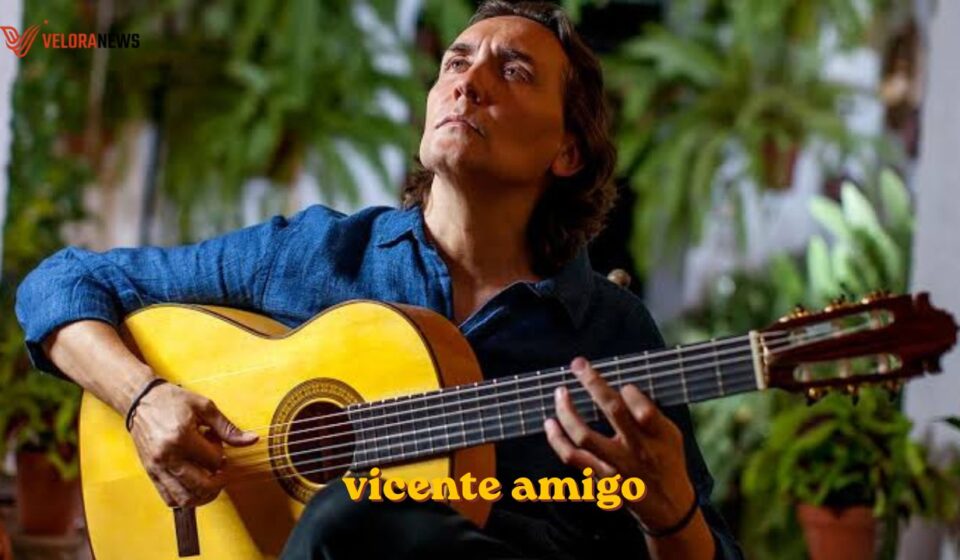

If you are discovering Vicente Amigo for the first time, it can be difficult to know where to begin. His name appears alongside the greatest figures in modern flamenco, yet his music does not fit neatly into a single category. Some recordings are intensely traditional; others bring in jazz, orchestral textures, Latin rhythms, or contemporary production. That combination is precisely what makes his career worth exploring.
Vicente Amigo is a Spanish flamenco guitarist and composer who was born in Guadalcanal, Seville, in 1967, but grew up in Córdoba. He began learning guitar as a child and eventually studied with major figures including Manolo Sanlúcar. His professional career developed rapidly, taking him from prestigious flamenco competitions to international stages and collaborations with artists outside the genre.
This guide explains who Vicente Amigo is, how his playing developed, which albums matter most, why Ciudad de las Ideas remains so important, and what makes his guitar style different from other modern flamenco players.
Who Is Vicente Amigo?
Vicente Amigo Girol is one of the most respected Spanish flamenco guitarists of his generation. Although he was born in Guadalcanal, his artistic identity is strongly associated with Córdoba, where he grew up and began developing his musical voice.
He received his first Spanish guitar at eight years old. His early teachers included “El Tomate” and “El Merengue,” before he became a student of the celebrated guitarist Manolo Sanlúcar. That progression was important because it connected Amigo with the traditional flamenco guitar while giving him access to a highly disciplined approach to composition and accompaniment.
Rather than treating flamenco as a fixed musical language, Amigo has spent much of his career testing how far the form can evolve without losing its identity.
That balance is probably the best way to understand his work.
Vicente Amigo’s Early Career
Amigo’s professional breakthrough came during the late 1980s.
In 1988, he entered the Festival Nacional del Cante de las Minas de La Unión and won first prize in the guitar category. The following year, he received the prestigious Ramón Montoya Prize for concert guitar at the Concurso Nacional de Arte Flamenco de Córdoba.
These awards mattered because flamenco guitar is not simply judged on technical speed. A guitarist has to understand rhythm, phrasing, accompaniment, harmony, dynamics and the emotional vocabulary of different flamenco forms.
Amigo was therefore being recognized at a young age not merely as a technically capable player, but as a serious flamenco musician.
His early professional experience also included accompanying singers and working within the tradition before establishing himself as a solo artist. That background became particularly important later: even when his compositions became more sophisticated and expansive, the rhythmic instincts of an accompanying flamenco guitarist remained underneath the music.
The Influence of Manolo Sanlúcar
One of the most important names in Vicente Amigo’s development is Manolo Sanlúcar.
Studying under Sanlúcar gave Amigo a connection to one of the major intellectual and musical traditions of modern flamenco guitar. Amigo’s early years were therefore not based simply on learning impressive guitar techniques. He was absorbing the architecture of flamenco itself.
This distinction helps explain something listeners often notice.
A newcomer may hear rapid picado passages and assume that speed is the defining feature of Amigo’s playing. It isn’t.
His real strength is the relationship between technique, melody and rhythm.
The fast passages work because they emerge from musical phrases rather than existing as isolated demonstrations of dexterity.
From Accompaniment to Solo Guitar
Before becoming internationally recognized as a solo artist, Amigo gained experience accompanying flamenco performers.
That background is easy to overlook, but it is one of the reasons his compositions can sound so rhythmically alive.
A solo guitarist can concentrate entirely on his own musical line. An accompanying guitarist has to listen constantly to another performer, anticipate changes, leave space, react to rhythm and understand when to push the music forward or hold it back.
Amigo carried those skills into his solo recordings.
His first major solo album, De Mi Corazón al Aire, appeared in 1991. The album received the Ícaro and El Ojo Crítico awards, helping establish him beyond the specialist flamenco scene.
His career expanded internationally soon afterward. He appeared at the 1991 “Leyendas de la Guitarra” festival in Seville alongside major musicians including Bob Dylan, Keith Richards, Paco de Lucía and Joe Cocker.
What Makes Vicente Amigo’s Guitar Style Different?
The easiest mistake when discussing Amigo is to describe him simply as a “virtuoso.”
He certainly possesses extraordinary technique, but that description misses the more interesting part of his artistry.
1. He treats melody as seriously as technique
Amigo’s guitar frequently behaves almost like a singing voice.
Instead of building a piece entirely around rapid runs, he can create long melodic phrases that breathe and develop. This is one reason his recordings can appeal to listeners who do not normally listen to flamenco.
2. Rhythm remains central
Flamenco depends heavily on rhythmic structures known as compás. Forms such as bulerías, soleá and tangos have distinctive rhythmic identities.
Amigo can expand the harmonic and instrumental palette of flamenco without abandoning that rhythmic foundation.
That is a difficult balance.
3. He is comfortable outside strict genre boundaries
His musical interests have extended beyond traditional flamenco. Sources documenting his career note influences and collaborations involving jazz and broader world music, while his recordings have incorporated different instrumental colors and production approaches.
The result is music that can sound unmistakably flamenco without necessarily resembling an older flamenco recording.
The Albums You Should Know
Vicente Amigo’s discography provides a useful map of his artistic development. His official discography lists nine studio albums, from De Mi Corazón al Aire in 1991 through Andenes del Tiempo in 2024.
De Mi Corazón al Aire — 1991
This is the natural starting point for anyone interested in Amigo’s early work.
It introduced his voice as a solo guitarist and demonstrated how confidently he could move from traditional flamenco vocabulary toward a more personal compositional style.
Vivencias Imaginadas — 1995
This album continued the development of his individual sound.
For listeners exploring his career chronologically, it is useful because it shows that his artistic evolution was gradual rather than a sudden departure from traditional flamenco.
Poeta — 1997
Poeta represents another important stage in Amigo’s willingness to expand the possibilities of flamenco guitar.
The project connected flamenco guitar with orchestral writing, demonstrating that his ambitions extended beyond the standard format of a guitarist accompanying singers.
Ciudad de las Ideas — 2000
If you only want to hear one Vicente Amigo album to understand his international reputation, this is arguably the best place to start.
Ciudad de las Ideas became one of the defining recordings of his career. It won the Latin Grammy for Best Flamenco Album in 2001 and also received wider critical attention for combining flamenco tradition with contemporary musical influences.
It was nominated for Album of the Year at the Latin Grammys as well, illustrating how far Amigo’s music had moved beyond a narrowly defined flamenco audience.
One particularly useful way to approach the album is not to ask whether it is “traditional” or “fusion.”
It is better understood as flamenco thinking applied to a broader musical vocabulary.
Un Momento en el Sonido — 2004
This record continued his exploration of sound and composition after the international success of Ciudad de las Ideas.
Paseo de Gracia — 2009
With Paseo de Gracia, Amigo continued developing a polished contemporary flamenco sound while retaining the expressive qualities of his guitar.
Tierra — 2013
Tierra further demonstrated his interest in creating music that could sit comfortably between flamenco and wider contemporary traditions.
Memoria de los Sentidos — 2017
This album returned attention strongly to flamenco’s roots while featuring prominent collaborators from the flamenco world.
It was nominated for Best Global Music Album at the 60th Grammy Awards. The official Grammy database lists Amigo as a nominee for the album, rather than a Grammy winner.
That distinction is worth making because biographies sometimes blur the difference between a Latin Grammy and a Grammy Award.
Andenes del Tiempo — 2024
Andenes del Tiempo is the most recent studio album listed in Amigo’s official discography.
The project is particularly interesting because it is instrumental and explores multiple flamenco and Spanish musical forms, including bulerías, soleá, tanguillos, pasodobles, rumbas and boleros. The title piece has been described as having a cinematic character.
For someone wanting to understand where Amigo’s music stands today, this is the album that should not be skipped.
Vicente Amigo and Paco de Lucía
Any discussion of modern flamenco guitar eventually reaches Paco de Lucía, and Amigo’s career is often discussed in relation to him.
The comparison makes sense historically. Both players pushed flamenco guitar toward larger concert settings and broader international audiences.
But treating Vicente Amigo as simply a successor or copy of Paco de Lucía does not do justice to either musician.
Amigo has developed his own vocabulary, particularly in the way he combines lyrical melodies, harmonic color and flamenco rhythm.
Their relationship is better understood as part of a larger evolution of flamenco guitar: tradition creates the foundation, influential artists expand its vocabulary, and subsequent generations develop their own answers.
His Collaborations Beyond Flamenco
Another important part of Amigo’s career is his willingness to collaborate outside conventional flamenco circles.
His documented work has included collaborations associated with artists such as Sting, Alejandro Sanz, Miguel Bosé and Eliane Elias.
This matters because collaboration can reveal whether an artist’s musical language works outside its original environment.
In Amigo’s case, his guitar remains identifiable even when the surrounding instrumentation changes.
That is a useful test of artistic identity: remove the familiar setting and see whether the musician still sounds like himself.
Awards and Recognition
Vicente Amigo’s career has received recognition from both musical institutions and the Spanish cultural establishment.
Among the most important distinctions are:
- First prize for guitar at the Festival Nacional del Cante de las Minas in 1988.
- Ramón Montoya Prize at the 1989 Concurso Nacional de Arte Flamenco de Córdoba.
- Latin Grammy for Best Flamenco Album for Ciudad de las Ideas in 2001.
- Ondas Award associated with Ciudad de las Ideas in 2002.
- Medalla de Andalucía for his professional career.
- Gold Medal of Merit in the Fine Arts, awarded by the Spanish government for 2015 and formally presented in 2016.
The Gold Medal is particularly significant because it recognizes not simply a successful recording but an artist’s broader contribution to Spanish artistic culture.
Three Things About Vicente Amigo That Are Easy to Miss
His Córdoba connection is more important than his birthplace
Amigo was born in Guadalcanal, Seville, but Córdoba shaped his musical education and identity. The city became central to his development from childhood onward.
That distinction matters when trying to understand his place within Andalusian flamenco.
His accompaniment background shaped his solo career
The ability to accompany singers is sometimes treated as a secondary skill compared with solo virtuosity.
For Amigo, it appears to have been part of the foundation of his musical maturity. His compositions often feel conversational because he understands how musical phrases interact rather than simply how a guitarist can fill space.
His greatest innovation is restraint
This may sound surprising when discussing a technically brilliant guitarist.
But one of Amigo’s most valuable qualities is knowing when not to play.
Flamenco is highly expressive, and an impressive technique can easily overwhelm a composition. Amigo’s strongest moments often come when speed serves the melody instead of becoming the melody.
That is one reason his music can remain compelling after the initial impression of virtuosity fades.
How to Start Listening to Vicente Amigo
If you are completely new to his music, listening chronologically is useful, but a focused route is even better.
Try this progression:
- Start with Ciudad de las Ideas to hear his mature international sound.
- Go back to De Mi Corazón al Aire to understand his early solo identity.
- Listen to Poeta to hear his interest in orchestral possibilities.
- Explore Memoria de los Sentidos for a stronger connection with contemporary flamenco tradition.
- Finish with Andenes del Tiempo to hear the direction of his later work.
While listening, pay attention to three things: rhythm, melody and silence.
The first tells you how deeply the music remains rooted in flamenco. The second reveals Amigo’s compositional personality. The third shows why his playing is more sophisticated than simple displays of guitar technique.
Is Vicente Amigo a Good Guitarist for Beginners to Study?
For someone learning guitar, Amigo can be inspiring but challenging.
His music contains techniques associated with advanced flamenco playing, including rapid picado, intricate rhythmic patterns, complex chord movements and demanding right-hand coordination.
A beginner should not attempt to copy his fastest passages immediately.
A better approach is to study small musical ideas:
- Learn the rhythm before the notes.
- Practice short melodic phrases slowly.
- Separate right-hand technique from left-hand movement.
- Listen carefully to accents.
- Study how phrases begin and end.
- Increase speed only after the rhythm feels natural.
The biggest mistake is trying to reproduce the sound without understanding the compás underneath it.
In flamenco, rhythm is not decoration. It is the framework holding the music together.
Why Vicente Amigo Still Matters
Vicente Amigo’s importance is not based on one award or one famous album.
His career demonstrates that flamenco can evolve without becoming disconnected from its roots.
He inherited a deep tradition, learned from major teachers, developed through accompaniment, established himself as a solo composer and then expanded his musical language internationally. His recognition by Spain’s cultural institutions confirms that his contribution extends beyond the world of specialist guitar enthusiasts.
At the same time, his music rewards close listening.
The more familiar you become with flamenco rhythm, the more details begin to emerge. A phrase that initially sounds like a dazzling technical passage can reveal carefully constructed melody, rhythmic tension and controlled dynamics.
That is perhaps the most useful way to approach Vicente Amigo: not simply as a guitarist who plays extraordinarily fast, but as a composer who happens to possess extraordinary technical command of his instrument.
FAQ
Who is Vicente Amigo?
Vicente Amigo is a Spanish flamenco guitarist and composer born in Guadalcanal, Seville, in 1967 and raised in Córdoba. He became professionally prominent in the late 1980s and has built an international career as a solo musician and collaborator.
What is Vicente Amigo’s most famous album?
Ciudad de las Ideas is one of his best-known and most influential albums. Released in 2000, it won the Latin Grammy for Best Flamenco Album in 2001 and helped establish Amigo’s international reputation.
Did Vicente Amigo win a Grammy?
The distinction between the Grammy Awards and Latin Grammy Awards is important. Ciudad de las Ideas won a Latin Grammy, while Memoria de los Sentidos received a nomination at the 2018 Grammy Awards. The official Grammy database currently lists one Grammy nomination and no Grammy wins for Amigo.
What is Vicente Amigo’s latest album?
His official discography lists Andenes del Tiempo, released in 2024, as his latest studio album. The instrumental project explores several flamenco and related Spanish forms and represents an important recent chapter in his career.
Is Vicente Amigo influenced by Paco de Lucía?
Paco de Lucía is an important reference point when discussing modern flamenco guitar, and Amigo’s career developed within the generation that followed him. However, Amigo has established a distinctive musical identity through his own combination of flamenco rhythm, melodic writing, harmonic exploration and contemporary influences.
What makes Vicente Amigo’s guitar playing special?
His playing combines advanced flamenco technique with strong melodic composition and a sophisticated sense of rhythm. His greatest strength is not speed alone; it is his ability to use technique in service of musical expression, allowing traditional flamenco structures to coexist with broader contemporary sounds.
Conclusion
Vicente Amigo represents one of the most compelling developments in modern flamenco guitar. From his childhood in Córdoba and studies with Manolo Sanlúcar to his breakthrough in the late 1980s, internationally recognized albums and major cultural honors, his career has been built around one central idea: tradition does not have to mean standing still.
His discography shows that evolution clearly. De Mi Corazón al Aire introduced a distinctive solo voice, Ciudad de las Ideas brought that voice to a much wider audience, Memoria de los Sentidos reaffirmed his connection with flamenco, and Andenes del Tiempo demonstrates that his creative journey is still moving forward.
For new listeners, the best place to begin is not with the question of whether Vicente Amigo is the fastest or most technically impressive guitarist. Listen instead for how he shapes a phrase, handles rhythm and creates emotion from a single instrument.
That is where his artistry becomes easiest to understand.